
Products

 Products Overview
Newsela products are purpose-built to unlock student motivation, inspire teachers, and drive long-lasting learning outcomes.








Resources
About
Products OverviewNewsela products are purpose-built to unlock student motivation, inspire teachers, and drive long-lasting learning outcomes.
Everything you need to be successfully while using the Newsela suite of products.
Newsela launched in 2013 with a bold mission: Meaningful classroom learning for every student. Today, our team constantly strives to deliver powerful solutions that inspire our users.

National STEM Day is November 8, but you don’t need to wait for that date to get students curious about how the world works. Real-world science stories, hands-on investigations, engineering challenges, and career connections make great anytime lessons that help STEM feel relevant across grade levels.
Use National STEM Day as a starting point for students to investigate, build, test, question, and discover. Explore seasonal STEAM projects, STEM module activities, diverse career stories, teacher-created text sets, videos, and other resources to bring science, technology, engineering, and math into your classroom.
Give National STEM Day a seasonal spin with hands-on activities tied to fall, Halloween, and Thanksgiving. Students can explore everyday STEM concepts through changing leaves, candy chemistry, composting, and other real-world events that happen in October and November.
Seasonal STEAM activities
Open a seasonal category to find hands-on activities, related Newsela content, and more ideas for bringing the season into your STEM lessons.
| Activity | Sample content | Read more |
|---|---|---|
| Hidden colors of leaves |
|
Discover more Fall activities |
Scroll left to right to see the full table.
| Activity | Sample content | Read more |
|---|---|---|
| Rock Candy |
|
Discover more Halloween activities |
| Lava Lamp |
|
Discover more Halloween activities |
| Spooky Senses |
|
Discover more Halloween activities |
Scroll left to right to see the full table.
| Activity | Sample content | Read more |
|---|---|---|
| Making Butter |
|
Discover more Thanksgiving activities |
| Composting |
|
Discover more Thanksgiving activities |
Scroll left to right to see the full table.
Looking for a more targeted or in-depth National STEM Day project? Explore STEM module projects across disciplines like astronomy, chemistry, ecology, or physics. Students can choose from design challenges, investigations, or presentations, all paired with Newsela content to build context and background knowledge.
Newsela STEM module projects
Open a science discipline to compare project goals, hands-on activities, and related Newsela content students can use to build background knowledge and explore each topic.
| Activity | Purpose/Goal | Sample content |
|---|---|---|
| Design a Planetarium | Model planetary motion and scale to represent the solar system and connect it to the larger universe. |
|
| Model a Constellation | Model patterns of stars and compare how different cultures interpret and tell stories about constellations. |
|
Scroll left to right to see the full table.
| Activity | Purpose/Goal | Sample content |
|---|---|---|
| Design the perfect Pancake | Investigate how ingredients and matter interact and change during cooking, then apply those observations to pancake design. |
|
Scroll left to right to see the full table.
| Activity | Purpose/Goal | Sample content |
|---|---|---|
| Build a Solar Oven | Apply solar-energy concepts to design a device that uses sunlight as a renewable resource for cooking. |
|
| Design a Rainwater Collection System | Design a system that captures and stores rainfall while connecting precipitation to water conservation. |
|
| Design a Compost Heap | Design a composting system that reduces food waste and turns organic material into a reusable resource. |
|
Scroll left to right to see the full table.
| Activity | Purpose/Goal | Sample content |
|---|---|---|
| Build an Eco-Column | Build a model ecosystem to observe how living organisms interact with one another and with their environment. |
|
| Design a Habitat | Design a habitat that meets organisms’ needs within a particular biome or ecosystem. |
|
| Growing Plants | Investigate the conditions plants need to grow by designing and observing a controlled growing system. |
|
| Design a Desert Oasis | Design an oasis that accounts for desert conditions, water availability, and the needs of organisms in the ecosystem. |
|
| Design an Animal’s Adaptations | Explore how traits and adaptations help animals survive, then apply that thinking to an adaptation design. |
|
| Past, Present, and Future | Examine how ecosystems and conservation practices change over time and how people can influence those changes. |
|
| National Park Presentation | Research a national park and explain how its ecosystems, organisms, and conservation efforts are connected. |
|
Scroll left to right to see the full table.
| Activity | Purpose/Goal | Sample content |
|---|---|---|
| Design an Earthquake-Resistant Building | Apply knowledge of earthquakes and structural stability to design a building that can better withstand seismic forces. |
|
| Don’t Get Carried Away | Investigate erosion and flooding to explore how moving water reshapes Earth’s surface. |
|
Scroll left to right to see the full table.
| Activity | Purpose/Goal | Sample content |
|---|---|---|
| Meteorologist for a Day | Explore weather, forecasting, the atmosphere, and technology to understand how meteorologists study and predict conditions. |
|
Scroll left to right to see the full table.
| Activity | Purpose/Goal | Sample content |
|---|---|---|
| Design a Roller Coaster | Apply ideas about force, motion, and energy to design a roller coaster that balances thrills with safety. |
|
| Design a Skatepark | Use the engineering design process and ideas about force and motion to design a functional skatepark. |
|
Scroll left to right to see the full table.
| Activity | Purpose/Goal | Sample content |
|---|---|---|
| Design a Community Warning System | Design a technology-based warning system that helps a community communicate and respond to potential hazards. |
|
| Design a Self-Closing Gate | Use the engineering design process to develop and test a mechanism that allows a gate to close automatically. |
|
| Pixel Message | Explore how digital visual messages use pixels, symbols, and other cues to encode and communicate information. |
|
Scroll left to right to see the full table.
Explore the full collection
Find more STEM module projects in Newsela. Browse the complete collection to find another project that fits your students and current science focus.
National STEM Day is also an opportunity to introduce students to the people shaping science, technology, engineering, and math. Use these resources to highlight influential STEM professionals and innovators while helping students explore how people from different backgrounds contribute to scientific discovery and problem-solving.
Use this text set to introduce students to Black scientists, inventors, and engineers whose work has influenced STEM fields. Pull resources to support concepts you’re already teaching, or expand beyond National STEM Day and teach a full unit.
Black representation in STEM
Compare three Newsela Text Sets that highlight Black contributions, careers, experiences, and advocacy across STEM fields.
| Text Set | Description | Sample content |
|---|---|---|
| Black Barrier Breakers: Inventors and Scientists | This Text Set highlights examples of Black barrier breakers in the field of science. |
|
| Black Excellence in STEM | This Text Set highlights examples of Black men and women in STEM careers. |
|
| Advocacy for Health and Medicine in the Black Community | This Text Set highlights the influence of race in health and medicine. |
|
Scroll left to right to see the full table.
Explore the collection
Find more resources featuring Black representation in STEM. Browse the full Newsela collection for additional texts and classroom connections.
Introduce students to Asian American and Pacific Islander scientists and young innovators. These resources highlight discoveries, inventions, and career journeys that show how AAPI individuals contribute across STEM fields.
AAPI representation in STEM
Open a STEM topic to browse Newsela articles, biographies, and explainers featuring AAPI scientists and young innovators.
| Resource | Reading Level | Spanish? |
|---|---|---|
| Training citizen scientists to save forests in the Philippines Article |
580L–1690L
|
|
| Forest ecologist helps refashion Barbie dolls as scientists Article |
400L–1030L
|
|
| Meet Isabella Abbott, the “first lady of seaweed” Biography |
710L–1310L
|
Scroll left to right to see the full table.
| Resource | Reading Level | Spanish? |
|---|---|---|
| At 82, she coded an app: She just wanted a game she could win Article |
520L–1270L
|
|
| Chinese scientists invent new technology to print invisible messages Article |
510L–1430L
|
|
| Yemeni student excels in computer programming while learning English Article |
550L–1170L
|
✓ Yes |
Scroll left to right to see the full table.
| Resource | Reading Level | Spanish? |
|---|---|---|
| Florida middle schooler’s music therapy invention wins 3M Young Scientist Challenge Article |
490L–1040L
|
✓ Yes |
| She’s 14, loves Harry Potter, wants to find a compassionate cure for cancer Article |
580L–1080L
|
✓ Yes |
| Meet the 11-year-old inventor working to improve lead water testing Article |
590L–1280L
|
✓ Yes |
Scroll left to right to see the full table.
| Resource | Reading Level | Spanish? |
|---|---|---|
| What makes a good scientist? Explainer |
280L–930L
|
|
| Time magazine names 15-year-old scientist Gitanjali Rao its first-ever Kid of the Year Article |
540L–1170L
|
Scroll left to right to see the full table.
Explore the collection
Find more resources featuring AAPI representation in STEM. Browse the full Newsela collection for additional scientists, discoveries, inventions, and STEM stories.
Introduce students to Jewish scientists and innovators whose research and discoveries have shaped fields like physics, space exploration, and medicine. These resources include biographies and articles, along with science stories connected to well-known innovators and their work.
Jewish representation in STEM
Open a resource type to explore biographies and articles about Jewish scientists, discoveries, and contributions across STEM fields.
| Resource | Reading Level | Spanish? |
|---|---|---|
| Inventors and Scientists: Albert Einstein Biography |
520L–1420L
|
✓ Yes |
| Scientist Lise Meitner helped discover nuclear fission Biography |
550L–1140L
|
Scroll left to right to see the full table.
| Resource | Reading Level | Spanish? |
|---|---|---|
| Europe’s 2020 Mars rover named for DNA pioneer Rosalind Franklin Article |
600L–1480L
|
|
| Physical features of Einstein’s brain befit a genius for the ages Article |
720L–1380L
|
|
| MIT students solve spaghetti-breaking problem that stumped famed physicist Article |
450L–1220L
|
✓ Yes |
| How to disguise a Nobel Prize Article |
500L–1230L
|
Scroll left to right to see the full table.
Explore the collection
Find more resources featuring Jewish representation in STEM. Browse the full Newsela collection for additional scientists, innovators, discoveries, and STEM stories.
Use this text set, created by educator Samantha Ament, to explore the contributions and influence of women in science. This middle school lesson works in both science and ELA classes and focuses on the compelling question: What are some examples of intelligent and influential women in science?
Women’s representation in STEM
Open a resource group to find biographies, articles, and an explainer featuring women whose discoveries, careers, and contributions have influenced science and STEM fields.
| Resource | Reading Level |
|---|---|
| Inventors and Scientists: Maria Mitchell Biography |
580L–1260L
|
| Inventors and Scientists: Grace Murray Hopper Biography |
450L–1110L
|
| Scientist Lise Meitner helped discover nuclear fission Biography |
550L–1140L
|
| Inventors and Scientists: Marie Curie Biography |
580L–1060L
|
Scroll left to right to see the full table.
| Resource | Reading Level |
|---|---|
| The Royal Society’s lost women scientists Article |
570L–1260L
|
| Europe’s 2020 Mars rover named for DNA pioneer Rosalind Franklin Article |
600L–1480L
|
| TV series reveals careers in science, technology, engineering, math for women Article |
400L–1000L
|
| The history of women at NASA Explainer |
580L–1360L
|
| This coloring book shows what a scientist really looks like Article |
490L–1410L
|
Scroll left to right to see the full table.
Explore the Text Set
Continue exploring women’s representation in STEM. Open the complete Newsela Text Set to use the resources together with the lesson’s compelling question and student activities.
Help students see how broad and diverse the STEM world can be with this text set. They can choose at least two resources, annotate each person's or group's contributions, and reflect on why representation matters in STEM.
Diverse representation in STEM
Open a representation focus to explore Newsela articles and biographies featuring people, communities, and pathways that broaden students’ understanding of who participates in STEM.
| Resource | Reading Level | Spanish? |
|---|---|---|
| Opinion: Chadwick Boseman’s Black Panther gives a boost to diversity in STEM Article |
640L–1350L
|
|
| NASA astronaut Jessica Watkins becomes first Black woman to join space station crew Article |
540L–1300L
|
|
| Victor Glover becomes first Black astronaut to arrive at space station for long-term stay Article |
600L–1370L
|
|
| Black STEM students keep Philadelphia’s school technology in working order Article |
610L–1490L
|
|
| More girls and African-Americans enroll in AP computer science Article |
600L–1390L
|
Scroll left to right to see the full table.
| Resource | Reading Level | Spanish? |
|---|---|---|
| A power list of the Latinx scientists who are changing the world: Part 1 Article |
640L–1490L
|
|
| A power list of the Latinx scientists who are changing the world: Part 2 Article |
630L–1400L
|
|
| Astronaut Nicole Mann: First Indigenous women in space awed by Mother Earth Biography |
550L–1390L
|
|
| Mexican-born engineer pushing for more diversity in space Article |
590L–1350L
|
✓ Yes |
| Ellen Ochoa: first Latina in space and former director of Johnson Space Center Biography |
570L–1340L
|
✓ Yes |
Scroll left to right to see the full table.
| Resource | Reading Level | Spanish? |
|---|---|---|
| Sight unseen: Teacher brings science to life for students who are blind Article |
560L–1240L
|
|
| NASA astrophysicist Jane Rigby named 2022 LGBTQ+ Scientist of the Year Article |
650L–1440L
|
|
| More than ever, 3 in 10 children asked to draw a scientist drew a woman Article |
610L–1270L
|
✓ Yes |
| Defying gender stereotypes, Indiana school pushes girls into science Article |
610L–1410L
|
Scroll left to right to see the full table.
| Resource | Reading Level | Spanish? |
|---|---|---|
| Online comics series is designed to teach children all about science Article |
410L–930L
|
✓ Yes |
| Esports seen as pathway to boost diversity in STEM careers Article |
610L–1410L
|
Scroll left to right to see the full table.
Explore the Text Set
Continue exploring diversity and representation in STEM. Open the complete Newsela Text Set to have students choose resources, annotate people’s contributions, and reflect on why diversity matters in science.
Want to see how other teachers are bringing STEM into their classrooms? Explore teacher-created text sets from our Newselaverse community members covering topics like AI, engineering, coding, and scientific inquiry. Each collection pairs a compelling or essential question with classroom instructions and in-class resources.
Teacher-created STEM Text Sets
Open a STEM topic to explore teacher-created Text Sets with classroom questions, instructional ideas, and sample Newsela content.
| Text Set | Teaching focus | Sample content |
|---|---|---|
| How will AI change the world? Created by Jennifer Lawson | Students examine familiar uses of AI, read multiple perspectives, and use evidence to consider how artificial intelligence could change the world. |
|
| Are electric cars a viable alternative to gas? Created by Scott Snyder | Students compare gas and electric vehicles, evaluate evidence, and defend, challenge, or qualify whether electric cars are a viable alternative. |
|
| Robots in Disguise—Have we gone too far? Created by Laura Roberts | Students evaluate claims about robots replacing human work, examine evidence about automation, and prepare to debate limits on AI and robotics. |
|
| Automation: Self-Driving Cars Created by Isaac Zimmermann | Students analyze competing ideas about self-driving vehicles and gather evidence about how widespread automation could affect society. |
|
| Virtual Reality: A dizzying experience! Created by Lizette Day | Students compare virtual reality across industries, evaluate its advantages and disadvantages, and contrast virtual experiences with real-world ones. |
|
Scroll left to right to see the full table.
| Text Set | Teaching focus | Sample content |
|---|---|---|
| Computer Science Careers Created by Edward Murray | Students investigate computer science careers, identify useful skills and questions, and share what they discover with classmates. |
|
| Video Games Created by Donnie Cardone | Students examine evidence about potential benefits of video games and use examples from articles and video to support an argument. |
|
| Technology All Around Us Created by Mrs. Palomeque | Students connect everyday technologies to their own lives, compare texts, and build an evidence-based claim about technology’s impact. |
|
| Should Kids Learn to Code? Created by Daniel Gallagher | Students gather evidence about learning to code, then use a jigsaw discussion to compare findings and form their own opinions. |
|
| Gamer Girls and Beyond: Girls in Computer Science & Technology Created by Heather Hanks | Students examine barriers and changing pathways for girls in computer science while comparing STEM careers, programs, and opportunities. |
|
Scroll left to right to see the full table.
| Text Set | Teaching focus | Sample content |
|---|---|---|
| How Can 3D Printing Improve the Lives of Individuals? Created by Philip Friedman | Students investigate real-world uses of 3D printing and use evidence to propose ways the technology could improve people’s lives. |
|
| Creative Inventors Created by Emily Shull | Students compare inventions with the ideas that inspired them to explore where creative solutions and new products come from. |
|
| Makers Created by Ellen Fishter | Students study young makers and trace the planning, production, and exploration steps used to turn curiosity into products and inventions. |
|
Scroll left to right to see the full table.
| Text Set | Teaching focus | Sample content |
|---|---|---|
| Science Dream Jobs Created by Ashley Burger | Students explore science careers that interest them and identify the responsibilities and skills associated with different STEM jobs. |
|
| Scientific Method in the Real World Created by Matthew Zald | Students identify variables, questions, hypotheses, and results in real investigations to see how the scientific method works outside a textbook. |
|
Scroll left to right to see the full table.
| Text Set | Teaching focus | Sample content |
|---|---|---|
| Math in the World Around Us Created by John Marallo | Students identify mathematical connections in nature, sports, and other contexts and explain real-world phenomena using evidence from the texts. |
|
| Searching for Percentages and Ratios in the Real World Created by Brooke Millevoi | Students find percentages and ratios in everyday contexts, gather supporting details, and connect mathematical ideas to real-life examples. |
|
Scroll left to right to see the full table.
Explore the community collection
Find more STEM lessons created by teachers. Browse the Newsela Science Community collection for additional teacher-created Text Sets and classroom ideas.
Use Generation Genius videos to give students another way to explore STEM concepts through visual explanations and real-world connections. Choose from science and math videos for grades K–8, with topics across engineering, physics, measurement, and data science.
Use Generation Genius science videos to help students visualize foundational STEM concepts across scientific topics like motion, energy, and collisions. These videos range from accessible introductions to more complex engineering and physics applications.
Generation Genius science videos
Choose a grade band to find Generation Genius videos that connect science concepts to engineering, experimentation, and real-world STEM.
| Resource | Runtime | Connection |
|---|---|---|
| What is Engineering? | 10:53 | Gives you a direct engineering connection and introduces solving problems through design. |
| Pushes and Pulls | 9:38 | Very accessible foundation for force and motion, with easy hands-on testing. |
Scroll left to right to see the full table.
| Resource | Runtime | Connection |
|---|---|---|
| Energy Transfer | 11:06 | One of the strongest cross-cutting STEM concepts and easy to demonstrate with real-world systems. |
| Collisions | 11:26 | Great for prediction, testing variables, motion, energy, and engineering challenges. |
Scroll left to right to see the full table.
| Resource | Runtime | Connection |
|---|---|---|
| Engineering Design Process | 17:10 | Probably the strongest single National STEM Day video because it explicitly integrates problem-solving, testing, and redesign. |
| Newton’s Laws of Motion | 12:47 | Foundational physics with countless real-world STEM applications. |
| Electricity & Circuits | 14:48 | Brings science, technology, and engineering together in a very recognizable STEM context. |
Scroll left to right to see the full table.
Explore the collection
Find more Generation Genius science videos. Browse the full Newsela collection for additional science topics and classroom connections.
Use Generation Genius math videos to connect foundational math skills to engineering, science, and real-world problem-solving. Dig into helpful topics across grade bands like measurement, data displays, unit conversions, and drawing to scale.
Generation Genius math videos
Choose a grade band to find Generation Genius videos that connect math skills to science, engineering, data, and real-world STEM applications.
| Resource | Runtime | Connection |
|---|---|---|
| Intro to Measurements: Weight & Length | 12:15 | Measurement is fundamental to virtually every science and engineering investigation. |
| Intro to Data: Pictographs & Bar Graphs | 13:39 | Introduces the idea that STEM investigations produce data that can be organized and interpreted. |
Scroll left to right to see the full table.
| Resource | Runtime | Connection |
|---|---|---|
| Understanding the Basic Coordinate Plane | 11:17 | Useful for mapping, robotics, engineering design, graphing, and later mathematical modeling. |
| Convert Units of Measurement | 12:25 | Extremely practical across science, engineering, construction, and experimentation. |
Scroll left to right to see the full table.
| Resource | Runtime | Connection |
|---|---|---|
| Unit Rates | 13:23 | Applies directly to speed, efficiency, density, cost, and many other STEM quantities. |
| Scatter Plots (Displaying Bivariate Data) | 12:54 | Strong connection to experiments because students can investigate relationships between variables. |
| Scale Drawings (Using Scale Factor) | 15:58 | One of the clearest math-to-engineering connections in the entire collection. |
Scroll left to right to see the full table.
Explore the collection
Find more Generation Genius math videos. Browse the full Newsela collection for additional math topics and classroom connections.
Give students opportunities to manipulate variables, test ideas, and observe cause-and-effect relationships with interactive PhET simulations. These options cover simulations of force, motion, circuits, and friction. They give students both science- and math-focused ways to investigate STEM concepts.
PhET simulations
Open a STEM topic to find interactive simulations students can use to manipulate variables, test ideas, and observe what happens.
| Resource | Connection |
|---|---|
| Forces and Motion: Basics | Students can manipulate force, mass, friction, and motion, making this a versatile option for hands-on STEM investigation. |
| Collision Lab | Students can change masses and velocities and observe how those variables affect collisions. |
| Projectile Motion | Students can experiment with speed, angle, gravity, and trajectory to explore projectile motion. |
| Friction | Students can manipulate variables and immediately observe cause-and-effect relationships involving friction. |
Scroll left to right to see the full table.
| Resource | Connection |
|---|---|
| Energy Skate Park: Basics | Makes potential and kinetic energy visible so students can explore how energy changes as objects move. |
| Circuit Construction Kit: DC | Gives students an engineering-style investigation where they can build, test, troubleshoot, and redesign circuits. |
Scroll left to right to see the full table.
| Resource | Connection |
|---|---|
| Area Builder | Adds a math-focused investigation to the collection so students can explore STEM beyond physical science. |
Scroll left to right to see the full table.
Use science diagrams to help students visualize how STEM concepts work across experiments, systems, and scientific tools. These diagrams cover variables, force, and other key STEM concepts and work well across grade bands.
Science diagrams
Open a STEM topic to find diagrams that help students visualize scientific processes, tools, forces, energy, and engineered systems.
| Resource | Grade Level | Purpose |
|---|---|---|
| The types of variables | 3–12 | Independent, dependent, and controlled variables support experiments across science and engineering, making this a versatile diagram across a wide grade range. |
| All about microscopes | 4–12 | Shows how scientists use engineered tools to observe things humans can’t see unaided, connecting scientific investigation with technology. |
Scroll left to right to see the full table.
| Resource | Grade Level | Purpose |
|---|---|---|
| What is force? | 4–12 | Connects foundational force concepts to motion, machines, transportation, and engineering design challenges. |
| Jet propulsion in everyday life | 4–12 | Shows how force and motion concepts are applied in designed systems rather than remaining only abstract science ideas. |
Scroll left to right to see the full table.
| Resource | Grade Level | Purpose |
|---|---|---|
| Energy transformations | 4–5 | Helps students see how energy changes forms in electrical devices, machines, motion, heat, and light. |
| The battery circuit | 3–8 | Connects circuit components to everyday electrical systems and provides a clear technology and engineering application. |
| How turbines generate electricity | 6 | Shows how motion and energy work together in an engineered system to generate electricity. |
Scroll left to right to see the full table.
National STEM Day can be a starting point for the kinds of science learning you want students to experience all year. Newsela STEM with Generation Genius brings science, technology, and engineering together, with math as a complement, so students can connect core concepts to real-world questions and phenomena.
Use Newsela STEM to:

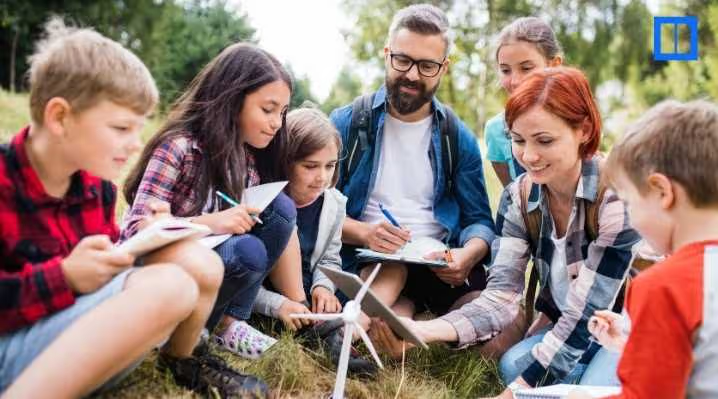
Discover what STEM education is, why it’s so important, and how you can overcome challenges to seamlessly integrate STEM lessons into any classroom or curriculum.
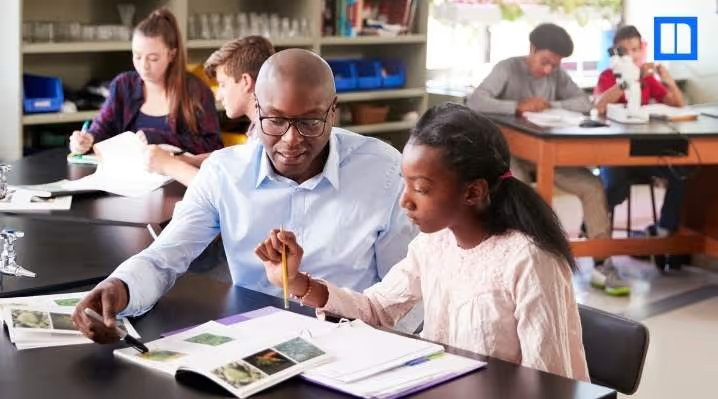
Discover 7 challenges teachers can have when incorporating STEM learning into their classrooms, and ways you can combat them for a more seamless implementation.
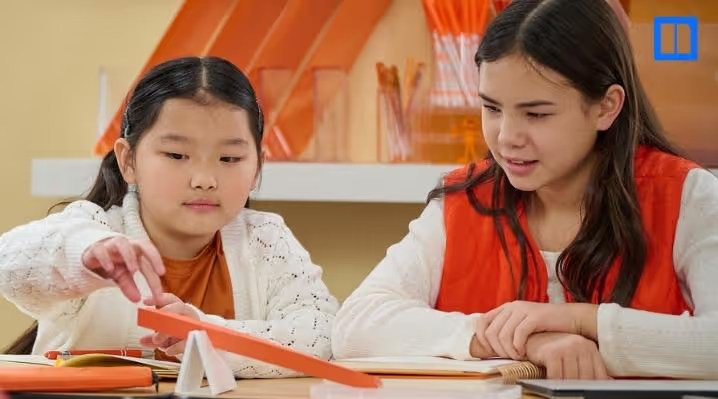
Learn how elementary science forms a foundation for future STEM education and get tips to make your lessons more engaging.


.jpg)
.jpg)